

Arctic and sub-arctic environments present a distinct set of challenges for drone operations. Low temperatures affect battery performance, reducing flight endurance. Limited daylight during winter months constrains visual operations. Strong and unpredictable winds create turbulence and increase energy consumption. Magnetic anomalies at high latitudes can affect compass-based navigation. And the remoteness of most Arctic operating areas means that logistics, communications, and support infrastructure are sparse. Despite these challenges, the demand for drone-enabled services in Arctic regions is growing. Infrastructure monitoring, environmental observation, search and rescue support, wildlife surveys, and ice condition assessment all benefit from aerial perspective and are often impractical to conduct by other means in these environments.
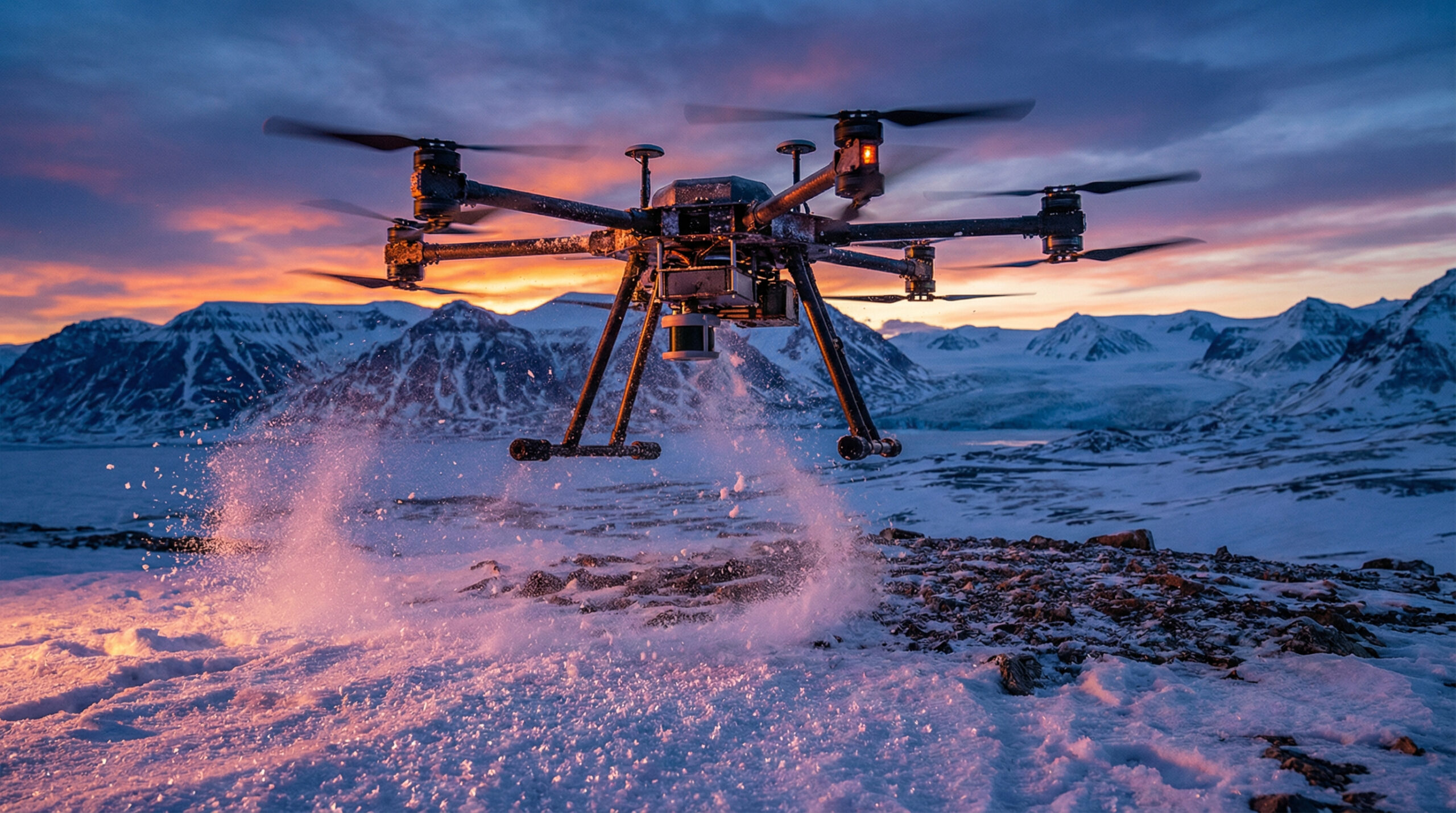
Environmental constraints on operations
Cold-weather operations require specific equipment preparation: insulated battery compartments, pre-heating systems, and materials rated for sub-zero operation. Flight planning must account for reduced battery capacity and increased power consumption due to denser cold air and wind loading. Communications infrastructure in Arctic regions is often limited to satellite links, which introduce latency and bandwidth constraints.
These constraints directly shape the operational design. Missions must be planned with greater safety margins. Edge processing becomes more important when satellite bandwidth is the only data path. And degraded-mode procedures must account for the possibility of rapid weather changes that exceed the forecast envelope.
Svalbard and high-latitude operations
Svalbard, at approximately 78°N, represents one of the most demanding environments for drone operations in Europe. Airspace management around Svalbard Airport (Longyearbyen) requires coordination with both civil aviation and the Governor of Svalbard. Environmental regulations are strict, reflecting the ecological sensitivity of the archipelago. And the combination of darkness, cold, and remoteness during winter months places extreme demands on equipment and procedures.
Operations in such environments test every aspect of the operational framework: equipment resilience, procedural robustness, communications reliability, and the ability of the remote operations centre to maintain effective supervision under degraded conditions. The lessons learned are applicable across a range of remote and harsh-environment operations.
Arctic-specific service delivery
Delivering drone services in Arctic environments requires more than cold-weather equipment. It requires operational designs that account for the full range of Arctic conditions, logistics planning that addresses remoteness and limited supply chains, and personnel who are trained and experienced in polar operations. Pre-positioning of equipment, multi-mode communications, and robust contingency planning are essential elements of Arctic operational readiness.